
门
Ordinary Life Resumes in Sierra Leone After Violent Protests: What Happened and Why?_我的网站

一 |
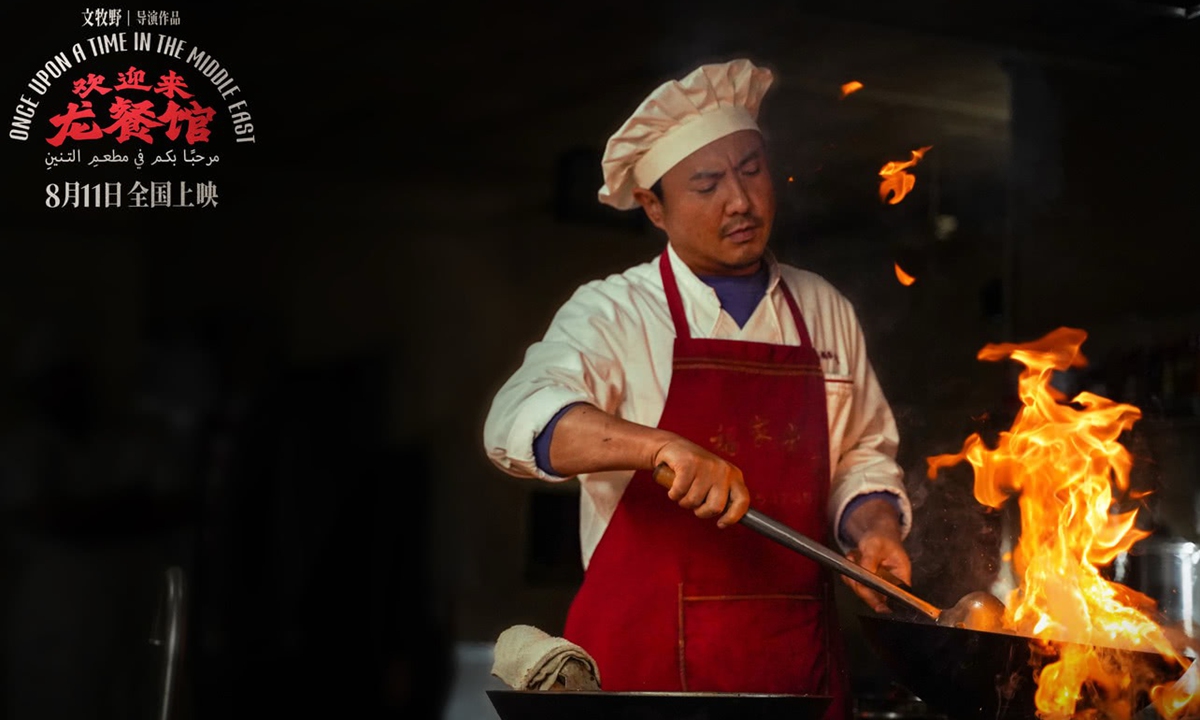
It centers on an ordinary Chinese chef caught in the crossfire of war. Shen Teng stars as Xu Fu, a cook who travels to the fictional Middle Eastern capital of Bahata to repay family debts. There he joins forces with restaurant manager Ma Junsheng (actor Jiang Qiming) to run a Chinese eatery. When conflict erupts, the self-preserving every-man endures personal losses and gradually comes to protect local children.
Produced by Ning Hao, the film continues Wen's signature focus on "little people," this time placing them far beyond China's borders.
In an interview with the Global Times, Wen talked about the project's connection to news reports of Chinese migrants who open restaurants overseas and forge quiet connections through food.
"Many Chinese people go abroad simply to make a living," he told the Global Times. "They open restaurants, use food to break down regional barriers, and form deep bonds with locals."
The production team conducted extensive research and location scouting in the Middle East to capture everyday details. Elements such as free-running single-humped camels required overseas shoots; the resulting images of open space after confinement, Wen noted, carry a simple sense of hope.
Food functions as the film's central motif.
"Food more often stands for happiness and peace," Wen explained. "Even in a war-torn environment, people still cannot do without three meals a day. That sounds basic, but after all the big things in life, what people care about most are the simplest things - eating a proper meal and taking care of family."
A specialized food unit developed the dishes, and Shen trained extensively so that most of the wok-tossing sequences were performed by the actor himself, Wen said.
The film deliberately intercuts kitchen routines with combat sequences.
"Three meals a day represent our longing for peaceful life, while war is the extreme act that destroys peaceful life on a large scale," Wen said. "When they collide, each becomes clearer: Food feels more ordered and full of happiness; war feels more chaotic and dark."
He hopes the juxtaposition helps audiences recognize how hard-won ordinary peace really is.
Xu Fu's decision to shelter orphans never relies on lofty rhetoric, only a meal and a roof. Wen described this approach as rooted in a human-centered outlook rather than classic Western hero narratives.
"We place more weight on humanism and the value of a person's existence. Our culture is about living well, studying well, eating well, and looking after children. No matter how large the events, three meals a day remain unavoidable. Food itself has warmth and can give people real strength when they are in a difficult situation," Wen said.
The director noted that he wants viewers to leave with the plainest conviction: live properly, eat properly, and cherish the peace that exists in the present.
On balancing personal expression with commercial reach, Wen kept his principle simple: "Make the film well and tell the story well. I try to put what I want to express into foreshadowing and details without hurting the viewing experience. If audiences notice those details, I will be glad. If they do not, it does not affect the normal narrative."
From Dying to Survive and Miracle: Stupid Kid to the new film, Wen's view of human complexity has remained consistent. "People have many different sides. They face different circumstances and make different choices."
The through-line, he added, is the same plain belief: "Being able to enjoy a proper meal is the greatest happiness."
Early audience response has been overwhelmingly positive. Advanced screenings delivered scores of 9.7-9.8 on major Chinese platforms including ticketing platform Maoyan.
Many entered expecting a light Shen Teng comedy and left in tears, describing the experience as "laughing then crying." Shen's restrained performance has drawn particular praise, with some calling it the strongest of his career. Jiang's supporting work has also been widely noted.
Moviegoers have frequently highlighted the film's refusal to deliver speeches. Its focus on daily meals and small acts of care lands more powerfully than any slogan.
On the depiction of the conflict, audiences observe that the movie offers a perspective that "flips the Hollywood script" by casting the US as the invader, while refusing to portray US soldiers as pure villains. Instead they appear as ordinary young men: loose in discipline and marked by the alienation of war.
Both Chinese and overseas viewers have singled out this measured approach as part of the film's distinctive Chinese viewpoint: It sidesteps both Western hero narratives and simple demonization. Some international comments note that by staying with ordinary lives rather than choosing geopolitical sides, the story offers a different lens on conflict.
One widely circulated comment from a popular Chinese self-media account on WeChat captured the film's ambition: "You can think of this film as a blend of Casablanca, Schindler's List, and The Shawshank Redemption, yet at its core lies the same grounded human compassion found in Dying to Survive. This is a highly successful attempt by Chinese filmmakers to surpass Hollywood. It is the first Chinese film that truly possesses a global vision and a professional sense of international storytelling. It is also a gift of warmth and goodwill from the Chinese people to a world still torn by war and cruelty."
。 Dozens of businesses, government offices, vehicles, and at least three police stations went up in flames in Freetown, Makeni, Kamakwie, and other cities across Sierra Leone from August 10 through 12, with over 113 people arrested and police introducing an emergency nationwide curfew and deploying tear gas and live ammunition to disperse crowds.,The curfew was lifted on August 13, with banks, businesses, government offices, and most stores reopened and communal services beginning to clear the damage. However, ramped-up security measures, including federal troop deployments to assist police, have been left in place.,What Happened?,Sierra Leone is one of the poorest nations in the world, ranking 186 out of 198 in a recent GDP purchasing power parity ranking. An estimated 80 percent of the population lives in poverty, many of them in the country’s rural areas. Like other nations in Africa, the country has faced special difficulties amid the global economic calamity brought on by COVID, and exacerbated by Western restrictions on Russian exports of agricultural goods and fertilizers amid the security crisis in Ukraine, which has caused a major jump in food prices.,AfricaAnti-Russia Sanctions Left Africa Without Access to Grain and Fertilisers, African Union Chief Says3 June, 11:13 GMT,As a net importer of both energy and food, Sierra Leone is especially vulnerable to global economic conditions, and along with food and fertilizers, fuel and electricity costs have also soared. Food prices alone have jumped by over 40 percent over the past few months, with a bag of rice once costing 350 leones now going for over 500. The country’s Central Bank recently removed three zeros from the national currency in a bid to restore confidence. The country has also been overcome by weeks of strikes by government workers, including doctors and teachers, and by small traders protesting poor conditions.,Coup Plot?,However, President Julius Maada Bio has also accused protesters of having ulterior motives beyond the cost of living crisis.,“This was not a protest against the high cost of living occasioned by the ongoing global economic crisis. The chant of the insurrectionists was for a violent overthrow of the democratically-elected government,” Bio said in an address on August 12 after returning to the country from a holiday in London.,Local media pointed to the chants of “Bio must go” among protesters as they gathered in the capital, and the president accused some of the demonstrators of consisting of “APC Warriors,” a reference to the opposition All People’s Congress party, which governed the country from 2007 until 2018, when Bio’s Sierra Leone People’s Party won national elections.,No doubt mindful of the violent civil war which shook the country between 1991 and 2002, claiming as many as 70,000 lives and displacing over 2.5 million people, Bio vowed that “in the coming weeks and months, [the] government will undertake necessary security actions meant to guarantee the peace and security of all citizens.”,“The security forces will, and must, act with great restraint and within their professional codes of service. But be assured that my government will crack down hard on violent insurrectionists, their collaborators, their sponsors and their supporters. My government will relentlessly fight those who would rather use terror and gruesome violence to achieve political goals,” the president said.,As a government, we will continue our engagement with Civil Society as we strive to promote sustainable peace, national cohesion and socio-economic development in Sierra Leone. #newdirectionagenda— President Julius Maada Bio (@PresidentBio) August 18, 2022,Bio did not elaborate on who these “sponsors” and “supporters” were, or whether they included any foreign actors.,Geopolitical Context,Like other African nations, Sierra Leone recently rejected calls by Washington and Brussels to show solidarity with the West and Ukraine and impose sanctions on Russia. But even before the escalation of the Ukraine crisis, relations between Freetown and Washington were tense at times. Last year, US President Joe Biden snubbed Bio by refusing to invite the African leader to the US’ so-called “Democracy Summit.” No reasons were given. However, neighboring Liberia, which faced mass civil unrest of its own between 2019 and 2020, and whose officials have been sanctioned by the US over suspected corruption, did get an invite.,While Sierra Leone maintains economic and political ties with its former British colonial masters, and remains a member of the Commonwealth of Nations, Freetown has sought to expand its partnerships with other geopolitical power centers, including Russia and China. President Bio attended the Russia-Africa Summit in Sochi in 2019, where he discussed ways to strengthen economic cooperation between the distant nations. In February 2021, Freetown signed onto Moscow’s efforts to prevent the deployment of weapons in outer space. In May 2021, Bio spoke by phone to President Xi Jinping of China, where they discussed the friendly, “brotherly” relations between the two nations, as well Chinese assistance to Freetown in measures against COVID, and agricultural and economic development.,In this context, the reactions of major foreign powers to this month’s unrest have been telling. While the United States, Britain, and the European Union collectively expressed “grave concern” over the “disturbing reports of violence” and urged the parties to “stay calm, promote accountability and ensure respect for human rights,” China’s Embassy smoothed over the protests altogether, refraining from wagging its finger at Freetown and instead trumpeting the expanding cooperation between the two countries.,We are gravely concerned by reports of violence surrounding today’s demonstrations in Sierra Leone. We urge all parties to stay calm, promote accountability, and ensure respect for human rights and fundamental freedoms.— Bureau of African Affairs (@AsstSecStateAF) August 10, 2022,Similarly, while UK High Commissioner to Sierra Leone Lisa Chesney lectured President Bio about how “violence has no place in a democracy and the necessary investigation into August 10 can sit alongside de-escalation,” the Russian Embassy in the Republic of Guinea, which concurrently serves as the Embassy in Sierra Leone, only presented a bare bones report on the situation in the country, Bio’s meetings with community and tribal leaders, and indicated that an internal “debriefing” was being created “regarding the causes, course and consequences of the riots on August 10.”。
Current article:http://www.lindunfokangliucishirun.shop/p80604x/vcxq.html
Published on:03:21:07


1
一日8%涨幅归零!比特币跳水 加密货币近25万人爆仓2
被解放军赶出黄岩岛,不到48小时,菲军带外军堵门,封海区已划下,尖锋视野,原创 被解放军赶出黄岩岛,不到48小时,菲军带外军堵门,封海区已划下3
मेष से कर्क Aaj Ka Rashifal 28 अगस्त 2025: वृषभ वालों के रुके हुए काम होंगे पूरे, जानें कैसा रहेगा दिन?4
杭州造“上天”了!一箭双星!5
蛇年到,福运到——东城中心幼新春祝福6
河北启动防汛四级应急响应7
猛龙补强新思路:巴雷特可当作筹码升级内线轮换8
China's auto exports top 1 million for second straight month9
“白海豚”离浙 今明仍有降雨10
围甲联赛次轮战罢 芈昱廷终结申真谞对中国棋手连胜11
深水规院:公司本期计提各项资产减值准备合计约2939万元12
迪萨西:加盟水晶宫主教练起了很大作用 期待同曼城的比赛13
学生专享:京东 PLUS 会员 49.5 元 / 年开学季年内探底14
重庆银行半年报:营收净利延续“双十”增长 集团及法人规模站稳“双万亿”15
记者:加拉塔萨雷不想为莱奥支付4000万欧元以上转会费
- 随机推荐
1
走近C罗的财富“守门员”:低调管家守住14亿美元2
通膨温和逐渐复苏NORDLYS(诺德利)看好亚太市场_投资_亚洲3
曾走出13天12板!跨界大牛股净利润同比转亏4
娱乐圈掀起“瘦身潮” 科学减重成全民新风5
华力创通:公司冲回各项资产减值准备共计约1435万元6
宫崎英高重申:FromSoftware 不会放弃单机游戏7
다문화가족 자녀 교육활동비 2억5천여만원 지원8
小熊维尼配音演员不满未能入选迪士尼“传奇奖”名人堂9
轰碎一切?美媒:全球威力最大常规导弹抵俄,战斗部重达2.5吨!,尖锋视野,原创 轰碎一切?美媒:全球威力最大常规导弹抵俄,战斗部重达2.5吨!10
全系RTX显卡免费升级 DLSS 4.5光线重建首测:游戏画面质的飞跃11
2026QMT量化交易详解|功能优势、开通条件与适用人群12
双喜临门!福彩“多喜乐”30元、50元新票上市,最高可中100万元13
记者:37岁埃里克·戈登将退役 结束18年NBA生涯14
Tropical Storm Norma forms off Mexico's Pacific coast15
Typhoon Dolphin causes water level of Shanghai’s Suzhou Creek to rise sharply(1/3)