秦时明月之君临天下
Chinese team develops intelligent vision sensor that turns light signals into AI-ready tokens, reducing use of energy_我的网站

一 |
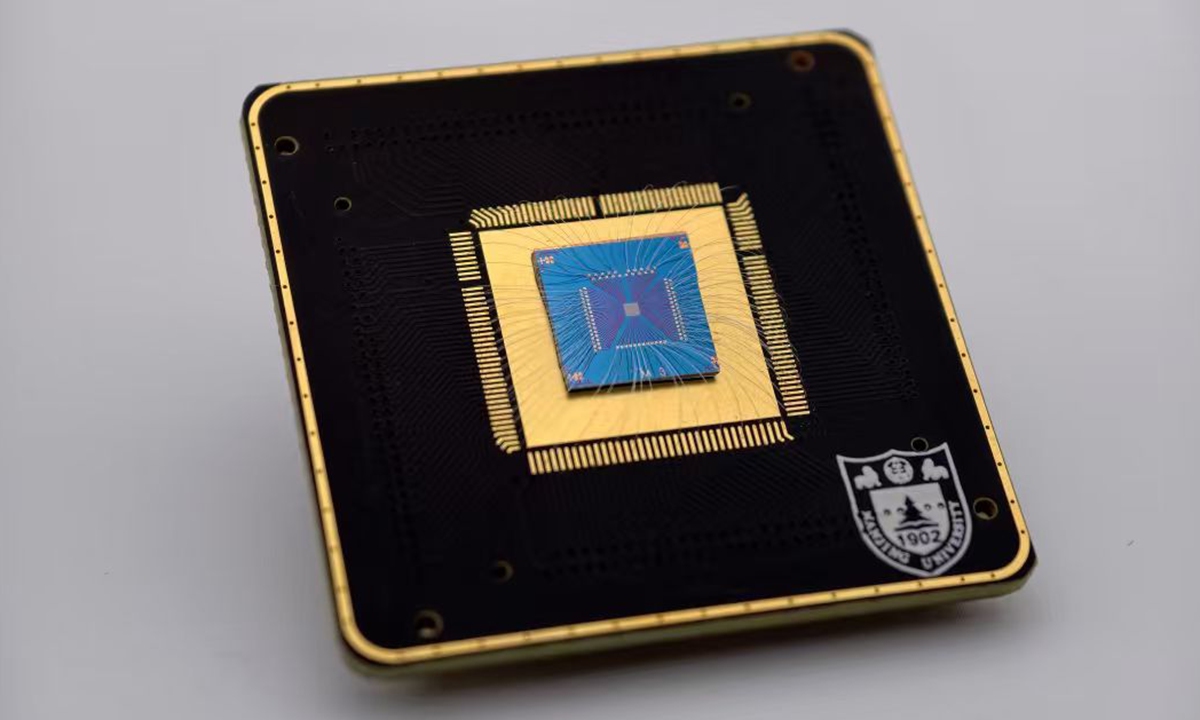
The new ultra-low-power intelligent vision sensor chip "LightTok" developed by a research team from Nanjing University. Photo: from Science and Technology Daily
A Chinese research team from Nanjing University has developed a new ultra-low-power intelligent vision sensor chip, dubbed "LightTok," that can convert light signals into tokens within the sensor, significantly reducing the high energy consumption caused by frequent transfers of massive amounts of redundant data, the principal investigator told the Global Times.
According to a release from the Institute of Brain-Inspired Intelligence of Nanjing University, tokens generated by the LightTok chip can be directly fed into a Transformer encoder for image recognition.
"Our design idea was to move token generation onto the sensor itself, allowing the chip to directly produce tokens that AI models can process once light reaches the sensor," Miao Feng, director of the Institute of Brain-Inspired Intelligence at Nanjing University, told the Global Times on Thursday. "These tokens contain complete image information."
Physical AI refers to intelligent systems capable of autonomously perceiving, reasoning, acting and receiving feedback in the real world, representing a key pathway for AI to move from the digital realm into the physical world. Vision-based physical AI systems powered by large AI models need to convert visual information from real-world environments into tokens that can be processed by AI models before feeding these tokens into Transformers for subsequent tasks.
In traditional visual perception pipelines, light signals must go through multiple stages, including image sensing, analog-to-digital conversion, data buffering and transfer, digital image patching and embedding, before being transformed into tokens that AI models can process. The frequent transfer of massive amounts of redundant data has resulted in high energy consumption at the edge, according to a report by Science and Technology Daily.
The LightTok chip directly addresses a key challenge in physical AI hardware: how to efficiently acquire and tokenize visual information from the physical world with low energy consumption, Miao said.
The LightTok chip consists of a photosensitive memory array and peripheral circuits. The team built the array based on single-layer molybdenum disulfide (MoS₂) floating-gate phototransistors, with each pixel capable of sensing light, storing information and performing analog computing. By processing optical information directly within the chip, the device can convert captured visual signals into tokens for AI models, according to the research team.
The current LightTok prototype has a resolution of 32×32 pixels, or 1,024 photosensitive pixels, which is still smaller than that of smartphone cameras and industrial imaging systems. However, Miao said the technology is compatible with CMOS manufacturing processes and can be scaled up. With wafer-level growth of molybdenum disulfide materials, the chip could potentially achieve a scale comparable to existing imaging devices.
Miao said the chip also draws inspiration from the information-processing mechanism of human vision. Similar to how the retina extracts key visual information before transmitting it to the brain, the chip also aims to process visual information at an early stage.
The research was conducted in collaboration with another research team from the National University of Singapore. The findings were published on Wednesday in Nature Sensors, an internationally renowned journal in the field of sensing technology, according to the release.
Potential applications for LightTok include drone systems, autonomous remote sensing and small-scale embodied AI systems, Miao said. In these scenarios, devices need to continuously detect, understand and track targets, generating massive amounts of visual data. By reducing the energy required for visual processing, the technology could extend the operating time of drones, satellites and small robots with limited power supplies, the expert said.
。

二 | 本网讯 记者佟玲报道
7月18日,市总工会组织党员干部到市反腐倡廉警示教育馆开展警示教育活动,市人大常委会副主任,市总工会党组书记、主席王忠平参加活动。
一个个案例、一段段警示录、一张张忏悔书,警示着每位党员干部要慎独慎微、自警自省,提醒着党员干部要深刻领悟以党纪学习教育推动全面从严治党向纵深发展的重要意义,进一步敲响了拒腐防变、正风肃纪警钟,强化纪律意识和规矩意识。

三 |
在党组书记王忠平的带领下,全体党员面向党旗高举右拳,重温入党誓词。
随后,大家依次在《廉政承诺书》上郑重签名。
党员干部纷纷表示,将在今后的工作和生活中,把遵规守纪刻印在心,内化为言行准则,进一步强化纪律意识、加强自我约束、提高免疫能力。市总工会将进一步推动党纪学习教育走深走实,持续教育引导广大党员始终以党规党纪为标尺正身立行,真正把纪律规矩转化为政治自觉、思想自觉、行动自觉,以党纪学习教育新成效,引领保障新时代工会工作高质量发展。
Current article:http://www.lindunfokangliucishirun.shop/tjppi8/0v2hk.html
Published on:10:01:23
 厦门:今明两天“隐形高温” 后天雨水驱暑
绝命毒师第五季
厦门:今明两天“隐形高温” 后天雨水驱暑
绝命毒师第五季
 华为首款新国标 3C 充电宝发售:100W 输出、12000mAh 容量、支持离线查找,399 元
天地传说之鱼美人
华为首款新国标 3C 充电宝发售:100W 输出、12000mAh 容量、支持离线查找,399 元
天地传说之鱼美人
 快乐8:广西中出一注选九中九
巨星秀
快乐8:广西中出一注选九中九
巨星秀
 微信
微信 移动端
移动端


